Play 3-6 months: hands, voice, mirror and movement
Play ideas for 3-6 months: grasping, mouthing, mirror, vocal sounds, tummy time, soft books, safety and when to ask for advice.
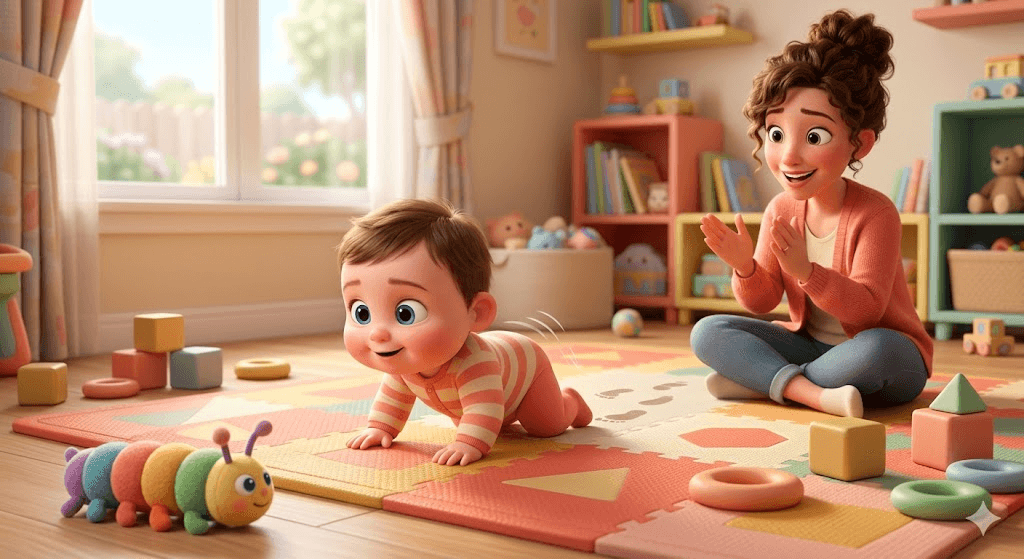
Between 3 and 6 months, babies become more active: they look, smile, bring hands to mouth, try to grasp and use their body to explore. Play can become more varied, but should remain simple and safe.
This guide complements tummy time, rolling baby, books in the first months and shared play.
What changes
In this stage you may see:
- more head control;
- hands brought to the mouth;
- attempts to grasp;
- vocal sounds and laughter;
- interest in faces, mirror and objects;
- early pushing on elbows or arms.
Not all babies do everything at the same time. Use play to observe progress, not to test.
Hand play
Offer large, clean, safe objects:
- soft ring;
- washable cloth;
- fabric book;
- sturdy rattle;
- large smooth spoon;
- large soft ball.
Your baby will mouth many objects: this is normal exploration. That is why you should avoid small parts, long ribbons, batteries, magnets and fragile objects.
Mirror and voice
A supervised unbreakable mirror can be interesting. Stay next to your baby:
- name the face;
- imitate sounds;
- pause;
- smile;
- wait for a response.
You can also read simple pictures, sing and repeat syllables. The value is not language performance, but turns of attention.
Floor movement
The mat becomes central. Alternate:
- back play with a toy above or to the side;
- tummy play with face or object in front;
- spontaneous rolling attempts;
- side toys to invite twisting;
- breaks in your arms.
Avoid too much time in bouncers or supports: it limits chances to move.
Games to avoid
Avoid:
- screens as entertainment;
- loud toys near the ear;
- small objects;
- long periods in restrictive seats;
- pulling arms to make baby sit;
- leaving baby on a bed or sofa.
If a game tires or agitates your baby, reduce stimulation and duration.
When to ask for advice
Talk with the pediatrician if:
- your baby does not use one hand or side;
- seems very stiff or floppy;
- does not react to sounds or faces;
- shows no progress with head control;
- loses skills;
- you have concerns about vision, hearing or movement.
Key takeaway
Play from 3 to 6 months is safe exploration: hands, mouth, voice, mirror and floor movement. A few good objects are worth more than many stimuli.
Useful links
Sources and further reading
- How Active is Your Baby? Tips to Get Infants Learning, Moving & Thriving - HealthyChildren.org - American Academy of Pediatrics
- Milestones by 4 Months - Centers for Disease Control and Prevention
- Milestones by 6 Months - Centers for Disease Control and Prevention
- How babies learn through play - UNICEF Parenting
- CDC's Developmental Milestones - Centers for Disease Control and Prevention
Sources are used to support general informational content and do not replace advice from a pediatrician or healthcare professional.