Tummy time: when to start and how to do it safely
Guide to tummy time: when to start, duration, positions, what to do if your baby dislikes it, safety and signs to discuss with the pediatrician.
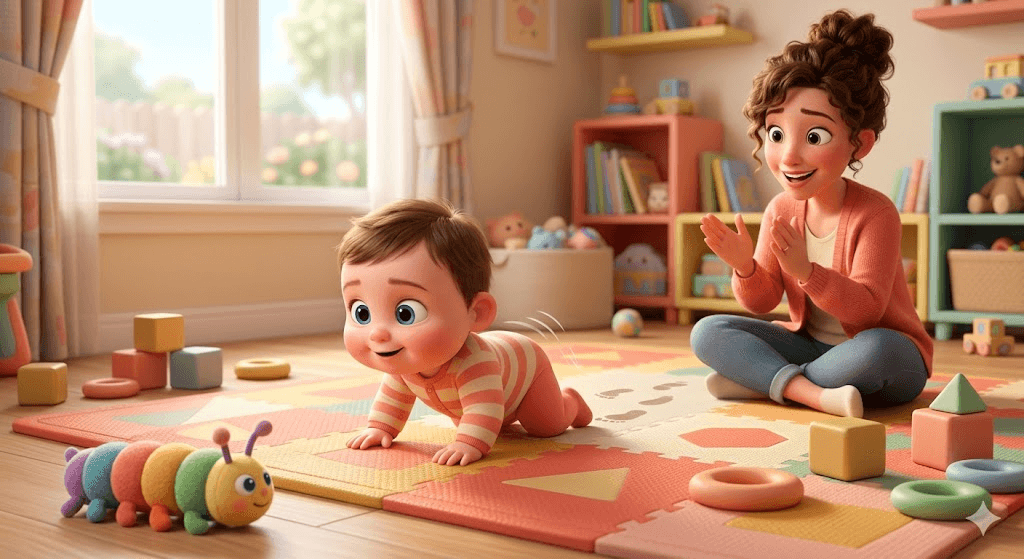
Tummy time is the time your baby spends on their stomach while awake and supervised. It helps the neck, shoulders, arms and trunk, and prepares for milestones such as rolling, sitting and floor movement.
This guide complements 0-3 month development, rolling baby, when baby sits and shared play.
When to start
Pediatric sources say you can start early, even in the first days at home, always with the baby awake and an adult present. At first, a few minutes several times a day are enough.
A simple approach:
- after a diaper change;
- when the baby is awake and calm;
- not right after a large feed;
- on the chest of an awake adult or on a stable mat;
- stopping when it becomes too tiring.
It is not an endurance test. Little and often works better.
Possible positions
Tummy time is not only "belly down on the floor".
You can try:
- baby on your chest while you are awake;
- tummy down across your legs;
- floor mat with an adult nearby;
- a rolled towel under the armpits if suitable and well positioned;
- your face or a simple toy in front of the baby.
The surface should be stable, away from edges, stairs, animals, unsupervised young siblings and small objects.
If your baby dislikes it
Many babies protest at first. It does not mean tummy time is wrong. Reduce duration and intensity:
- try 30-60 seconds;
- bring your face close;
- talk or sing;
- use a chest position;
- try again at another time;
- stop before intense crying.
The goal is to associate the position with interaction and safety, not to force your baby to "push through".
What to watch
Over time you may notice:
- briefly lifting the head;
- turning the face side to side;
- resting on elbows and forearms;
- pushing against the floor;
- looking at your face or an object;
- tolerating the position a little longer.
Every baby has a different pace. Gradual progress matters more than comparison.
Mistakes to avoid
Avoid:
- tummy time on a sofa or bed without protection;
- an adult falling asleep with baby on their chest;
- long sessions when baby is tired;
- doing it right after feeding if it causes discomfort;
- using soft unstable supports;
- leaving the baby alone even briefly.
Also reduce prolonged time in bouncers, car seats and seats when they are not needed: free movement on the floor offers different experiences.
When to ask for advice
Talk with the pediatrician if your baby:
- seems very stiff or very floppy;
- always uses one side and not the other;
- does not move arms or legs well;
- never tolerates the position despite short attempts;
- loses skills already shown;
- was premature or has specific instructions from the birth team.
You do not need to wait months when a concern persists.
Key takeaway
Tummy time is play, not training. A few repeated minutes, an adult nearby and respect for the baby's cues are the most useful foundation.
Useful links
Sources and further reading
- Back to Sleep, Tummy to Play - HealthyChildren.org - American Academy of Pediatrics
- How Active is Your Baby? Tips to Get Infants Learning, Moving & Thriving - HealthyChildren.org - American Academy of Pediatrics
- Baby moves - NHS
- How to keep your baby or toddler active - NHS
- CDC's Developmental Milestones - Centers for Disease Control and Prevention
Sources are used to support general informational content and do not replace advice from a pediatrician or healthcare professional.