Rolling over: when babies start and how to support it
When babies start rolling, how to prepare a safe space, what to watch, what to avoid and when to talk with the pediatrician.
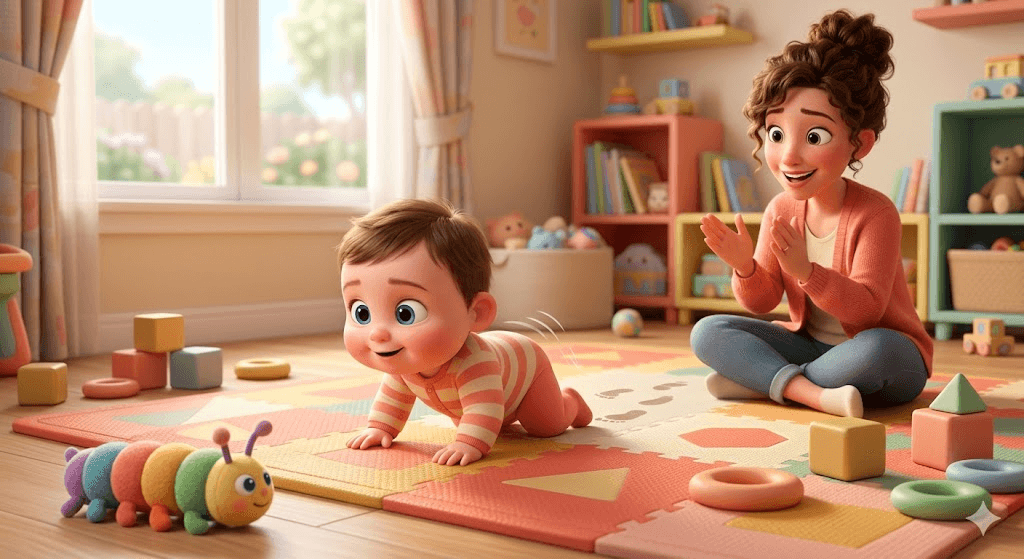
Rolling is one of the first experiences where a baby moves their whole body to change position. It comes after weeks of head control, pushing on the arms, kicking, twisting and curiosity about what they see.
This guide complements tummy time, when baby sits, 0-3 month development and safe baby sleep.
When it happens
Many babies begin trying to roll between 3 and 6 months, often first from tummy to back and later from back to tummy. AAP sources describe 4-7 months as a period rich in motor milestones, but variation is normal.
Do not focus on one exact date. Watch whether your baby:
- lifts head and chest;
- brings hands and feet toward the center;
- turns the head to both sides;
- pushes with legs and arms;
- tries to rotate the pelvis;
- shows curiosity toward toys placed to the side.
Safe space
As soon as your baby starts turning, high surfaces become riskier. The best place to practice is the floor on a stable mat.
Prepare:
- space away from stairs and sharp furniture;
- a few large safe toys;
- no small objects;
- adult nearby;
- non-slip mat;
- no sofas, beds or changing tables for "practice".
Never leave your baby on a high surface, even if they "do not roll yet": the first roll can happen suddenly.
How to support it
You do not need to pull your baby into a roll. You can make it easier by:
- alternating play on back and tummy;
- placing a toy slightly to the side;
- speaking from the less-used side;
- leaving space for legs;
- taking breaks;
- avoiding long periods in restrictive seats.
If your baby protests, return to a more comfortable position and try later.
Rolling and sleep
Keep placing your baby on their back for sleep. If they learn to roll independently during sleep, follow your pediatrician's guidance and always keep the crib clear: no pillows, bumpers, positioners or loose blankets.
If you use swaddling, read stopping swaddling for sleep: when rolling attempts appear, sleep management changes.
Asymmetries to watch
Some preferences are common, but report if:
- your baby always looks to one side only;
- uses one hand or leg much less;
- the body always curves one way;
- they cannot turn the head toward one side;
- they cry a lot in one specific position;
- they lose movements already present.
These signs are not a diagnosis, but they deserve clinical observation.
Key takeaway
Rolling grows from free movement, tummy time and safe space. Your role is to prepare the environment, watch symmetry and avoid forcing the milestone.
Useful links
Sources and further reading
- Movement Milestones: Babies 4 to 7 Months - HealthyChildren.org - American Academy of Pediatrics
- Is Your Baby's Physical Development on Track? - HealthyChildren.org - American Academy of Pediatrics
- Learning to move - NHS Children's Health
- CDC's Developmental Milestones - Centers for Disease Control and Prevention
- Early childhood development - UNICEF
Sources are used to support general informational content and do not replace advice from a pediatrician or healthcare professional.