NoiBimbo
  • Growth Guide
  • Tools
  • Checklists
Vai al contenuto
NoiBimbo

© 2026 NoiBimbo. All rights reserved.

Privacy PolicyTerms of ServiceAbout UsEditorial method

NoiBimbo content is for informational purposes only and does not replace professional medical advice.

  1. Home
  2. /
  3. Growth Guide
  4. /
  5. Safe baby-led weaning: practical rules
Feeding6-12 months

Safe baby-led weaning: practical rules

How to approach baby-led weaning safely: posture, cuts, textures, supervision, allergens, salt, sugar and foods to avoid.
8 min readPublished on July 4, 2026
Safe baby-led weaning: practical rules

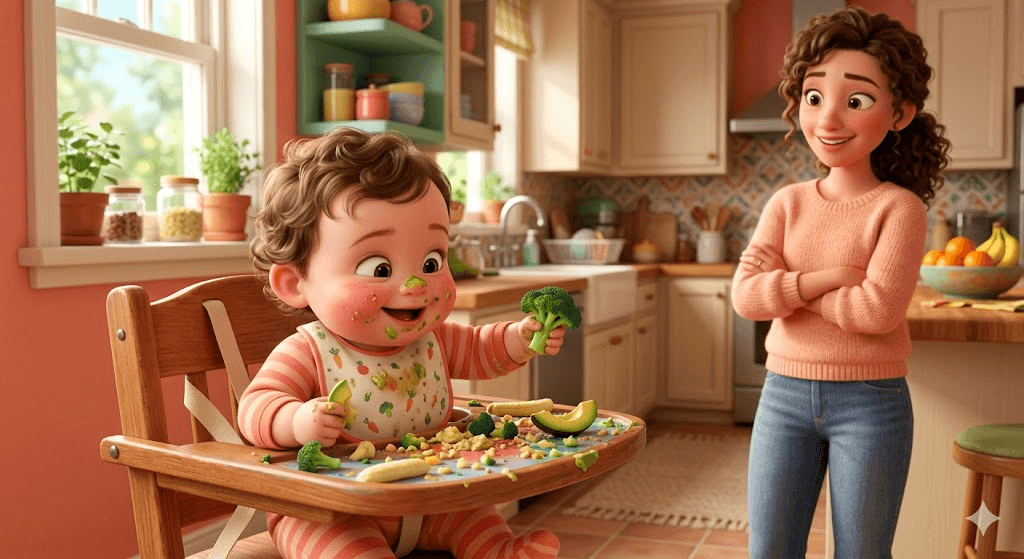
Baby-led weaning can be a valid way to introduce solids, but it does not mean offering adult food exactly as it is. Safety requires adapting textures, cuts, salt, sugar and the eating environment.

For the broader method, revisit baby-led weaning.

Readiness before method

Before starting, your baby should:

  • sit with good trunk control;
  • hold the head steady;
  • bring objects to the mouth;
  • show interest in food;
  • not automatically push everything out with the tongue.

If there is prematurity, growth difficulty, neurological concern or swallowing difficulty, ask for personalized guidance.

Safe environment

Every meal needs:

  • stable high chair;
  • baby sitting upright;
  • present and focused adult;
  • small amounts on the tray;
  • no food while playing or walking;
  • no whole round, hard or sticky foods.

Family food, modified

You can share parts of family meals if they are suitable:

  • no added salt;
  • no honey under 1 year;
  • no unnecessary sugars;
  • well cooked when needed;
  • cut safely;
  • allergens introduced according to pediatric guidance.

For high-risk foods, see foods to avoid in the first year.

Baby-led weaning does not mean leaving risk management to the baby. The adult chooses foods, cuts, posture and supervision.

Gagging and choking

Gagging can happen while learning. True choking needs immediate action. Before starting, it is sensible to learn infant choking first aid and read choking during weaning.

Key takeaway

Safe baby-led weaning means autonomy within clear boundaries: ready baby, suitable food, trained adult and constant supervision.

Useful links

  • Baby-led weaning
  • Safe food cuts for weaning
  • Textures during weaning
  • Foods to avoid in the first year
  • Safe cuts checklist

Sources and further reading

  • When, What, and How to Introduce Solid Foods - Centers for Disease Control and Prevention
  • Preparing food safely for babies - NHS
  • Choking Prevention for Babies & Children: What Every Parent Needs to Know - HealthyChildren.org - American Academy of Pediatrics
  • Foods to avoid giving babies and young children - NHS
  • Infant and young child feeding - World Health Organization

Sources are used to support general informational content and do not replace advice from a pediatrician or healthcare professional.

Back to Guide

Useful tools

  • Breastfeeding Timer

    Timer to track duration, side and time of feedings with daily log.

  • Baby Feeding Calculator

    Calculate how many feedings and how much milk your baby needs based on age and weight.

Related checklists

  • Feeding Diary

    Checklist to track feeds, amounts, hunger and fullness cues, diapers, burping and useful details to share with the pediatrician.

  • Bottle-Feeding Kit

    Checklist for a complete and safe bottle-feeding kit: bottles, nipples, sterilizing, measures, storage and outings.

Related Articles

  • Water during weaning: when to start and how much to offer
    Feeding

    Water during weaning: when to start and how much to offer

    How to introduce water from around 6 months: small sips with meals, milk still central, drinks to avoid and signs to watch.

    6-12 months
  • Stranger anxiety: what happens between 6 and 18 months
    Psychology

    Stranger anxiety: what happens between 6 and 18 months

    Why babies cry around new people, how to tell stranger anxiety from separation anxiety, and how to help without forcing contact.

    6-12 months
  • Drinking from a cup: moving from bottle to cup
    Psychology

    Drinking from a cup: moving from bottle to cup

    When to offer a cup, which cup to choose, how to reduce bottles and how to manage water, milk, spills and refusal.

    6-12 months