No and limits: how to hold boundaries without yelling
How to use a few clear rules, alternatives, calm consequences and positive attention with toddlers.
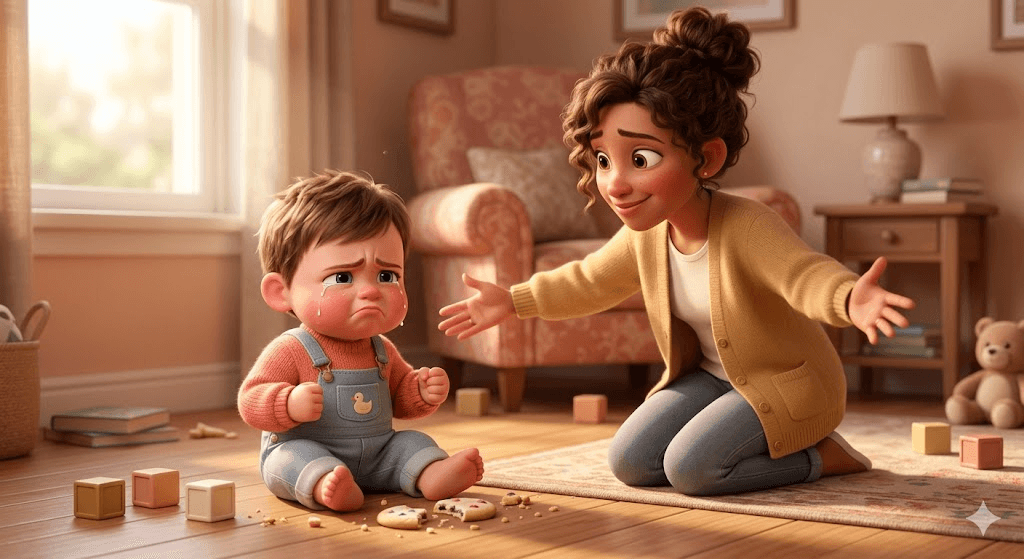
Saying "no" to a toddler is not a battle to win. It is a way to offer safety, protect bodies, respect others and build predictability. The issue is not the limit itself, but how it is given and repeated.
This guide complements tantrums and crying spells, toddler biting, child routines and family routine.
What limits are for
Limits help a child understand:
- what is safe;
- what hurts others;
- what happens every day;
- which behaviors receive attention;
- how to repair after a mistake.
Between 1 and 3 years, impulse control is still immature. That is why limits need to be repeated many times.
Fewer no's, clearer no's
Not every no has the same weight. Choose priorities:
- safety: roads, outlets, windows, stoves;
- body: no hitting, no biting, no pushing;
- respect: no grabbing from hands, no throwing hard objects;
- routines: diaper, sleep, leaving, meals.
If everything is forbidden, the child can no longer tell what really matters.
A practical formula
A simple sequence:
- stop: "I am stopping you. We do not throw the cup.";
- brief reason: "It can break and hurt someone.";
- alternative: "You can throw the soft ball.";
- action: remove the cup if it continues;
- positive attention when the alternative is used.
Use few words. The adult's action needs to be consistent.
Positive attention
Attention increases the behavior that receives attention. If you speak only when your child does something wrong, you may accidentally reinforce that behavior.
Notice what you want to see:
- "You waited for your turn.";
- "You held my hand.";
- "You put the toy in the box.";
- "You stopped when I said stop.";
Describe the action, not just "good job".
Calm consequences
A useful consequence is short, connected and immediate:
- throws the spoon: the spoon is removed for a moment;
- bites: pause from the situation and care for the bitten child;
- runs toward the road: holding hands becomes required;
- breaks a toy on purpose: the toy is put away.
The consequence should not frighten. It should teach.
What to avoid
Try to avoid:
- yelling as a regular strategy;
- threats you cannot keep;
- humiliating punishments;
- spanking;
- very long explanations during a meltdown;
- changing the rule every time.
If you lose your calm, you can repair: "I yelled, and that was not okay. The limit stays: no throwing."
When to ask for help
Talk with the pediatrician if behaviors often put safety at risk, if there are aggressive episodes with injuries, significant regressions, very long meltdowns or if adults can no longer manage the situation without fear.
Key takeaway
A good limit is clear, repeatable and connected to the relationship. A child does not learn because they are scared: they learn because a steady adult helps them stop and try an alternative.
Useful links
Sources and further reading
- What's the Best Way to Discipline My Child? - HealthyChildren.org - American Academy of Pediatrics
- How to Shape & Manage Your Young Child's Behavior - HealthyChildren.org - American Academy of Pediatrics
- Top Tips for Surviving Tantrums - HealthyChildren.org - American Academy of Pediatrics
- Your toddler's developmental milestones at 2 years - UNICEF Parenting
- CDC's Developmental Milestones - Centers for Disease Control and Prevention
Sources are used to support general informational content and do not replace advice from a pediatrician or healthcare professional.