Storing infant formula: timing, fridge and leftovers
How to store powdered, prepared and ready-to-feed formula: timing, fridge, transport, leftovers and contamination prevention.
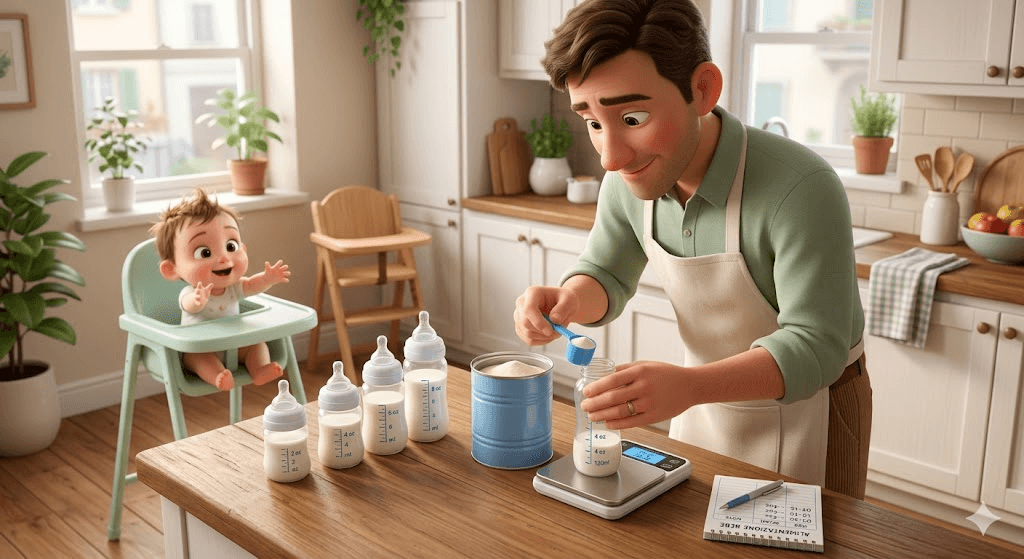
Formula storage is one of the areas where mistakes happen easily, especially at night or away from home. The principle is simple: the less time prepared formula stays warm, the lower the risk of bacterial growth.
For the preparation sequence, start with preparing infant formula.
Unopened and opened powder
Store unopened containers in a cool, dry place away from sunlight. Do not leave them in cars, garages, balconies or damp spaces.
After opening:
- close the lid tightly;
- store in a cool, dry place;
- do not refrigerate the powder;
- write the opening date on the lid;
- use within the time shown on the label;
- do not use after the use-by date.
Do not wash the inside of the container and do not wet the scoop. Powder should stay dry.
Prepared formula
Directions can vary by product and country. CDC states that prepared formula should be used within 2 hours of preparation and within 1 hour from when feeding begins. If you do not use it right away, put the bottle in the fridge immediately and use it within 24 hours.
NHS advises making feeds one at a time when needed to reduce infection risk. If you need a different routine, ask your pediatrician which strategy fits your baby.
Fridge and transport
If you refrigerate a prepared bottle:
- put it in the fridge immediately;
- keep it in the coldest part, not the door;
- label it with the preparation time;
- do not exceed recommended times;
- do not freeze prepared infant formula.
For going out, it is often safer to carry water and powder separately, or use ready-to-feed formula according to the label. If you carry a prepared bottle, you need an adequate cooler bag and very controlled timing.
Warming and not warming
Formula does not have to be warm. If your baby accepts it at room temperature, that is fine when safety rules are followed. If you warm it, use external warm water or a bottle warmer, then test drops on your wrist.
Do not use a microwave: it can create hot spots and burn the mouth.
Night and outings
At night, prepare the setup rather than necessarily preparing the milk. You can have sterilized bottles ready, water managed according to guidance, measured powder in clean containers and low light. The bottle-feeding kit checklist helps you remember the essentials.
Away from home, bring:
- clean bottles;
- separate powder dose;
- safe water according to guidance;
- cooler bag if needed;
- wipes for surfaces;
- a plan for discarding leftovers.
When to be more cautious
Use extra caution if your baby is under 2 months old, premature, immunocompromised or if water safety is uncertain. In these cases ask for precise instructions on formula type, water, temperature and timing.
If vomiting, diarrhea or signs of dehydration appear, contact the pediatrician.
Key takeaway
Prepared formula is not food to keep around "just in case". Prepare it when needed, cool and store it only within recommended times, throw away leftovers and do not improvise with fridges, cooler bags or microwaves.
Useful links
Sources and further reading
- Infant Formula Preparation and Storage - Centers for Disease Control and Prevention
- Handling Infant Formula Safely: What You Need to Know - U.S. Food and Drug Administration
- Safe preparation, storage and handling of powdered infant formula: guidelines - World Health Organization
- How to make up baby formula - NHS
- Infant and young child feeding - World Health Organization
Sources are used to support general informational content and do not replace advice from a pediatrician or healthcare professional.