Fever in a newborn: measurement and warning signs
How to take a temperature, when a newborn needs immediate assessment, and what to do while waiting without using risky remedies.
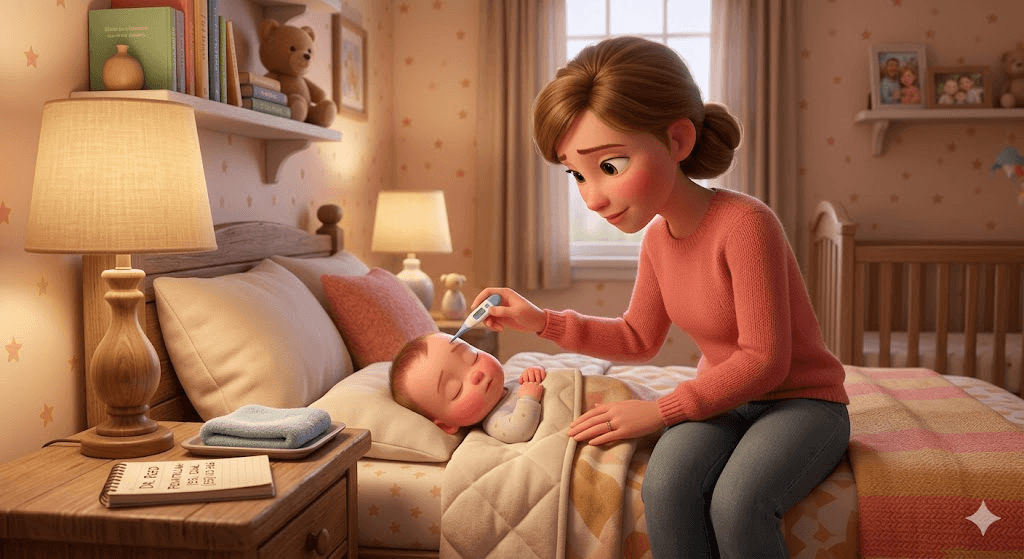
Fever needs more caution in the first three months than it does in older children. Do not interpret it only by how your baby looks: a newborn may need assessment even when they seem calm.
What temperature counts as fever
For a newborn, the commonly used threshold is 38.0 C (100.4 F) measured rectally. Readings from different body sites should not be converted by automatically adding or subtracting half a degree; each method has its own accuracy and limits.
A raised reading after crying, skin-to-skin contact, too many clothing layers or a warm room may fall when the baby settles and excess layers are removed. However, if the temperature reaches the threshold or your newborn seems unwell, repeat it with a reliable method without delaying medical advice.
How to take the temperature
Use a digital thermometer and record the reading, time and measurement site.
Rectal measurement
This is generally the most accurate method for young infants. Follow the device instructions, lubricate the tip and insert it very gently only to the stated depth. Stop if you feel resistance. If you are not comfortable doing this, ask your pediatrician to demonstrate a suitable method.
Underarm measurement
This is easy and useful as an initial check but is less precise. Place the tip in the center of a dry armpit and hold the arm against the body. A doubtful reading or one near the threshold should be confirmed as directed by a healthcare professional.
Forehead and ear devices
Temporal artery thermometers can be practical when used correctly. Ear thermometers are less reliable in very young babies because the ear canal is narrow. Forehead strips and touching the skin are not accurate enough to decide whether a fever is present.
Do not use glass mercury thermometers. Clean the device according to its instructions, and never use a thermometer orally after it has been used rectally.
Warning signs needing urgent help
Call emergency services immediately if your baby:
- is struggling to breathe, has breathing pauses or blue lips;
- is very floppy, unresponsive or difficult to wake;
- has a seizure;
- has purple or red spots that do not fade when pressed;
- is worsening quickly or appears to be in danger.
Seek prompt medical assessment even without a 38 C reading if your newborn:
- repeatedly refuses breast or bottle feeds;
- has far fewer wet diapers, a dry mouth or other signs of dehydration;
- repeatedly vomits, especially green fluid, blood or forceful jets;
- cries inconsolably or makes an unusually weak, high-pitched sound;
- looks very pale, gray or mottled;
- has a tense bulging soft spot, a worrying rash or worsening jaundice;
- has an unusually low temperature and appears unwell.
The guide on when to call the pediatrician can help you organize information but cannot replace clinical triage.
What to do while waiting for advice
- Offer breast milk or formula more often, without forcing feeds.
- Keep your baby in light clothing in a comfortable room.
- Record temperature, time, feeds, diapers and other symptoms.
- Have the exact age, recent weight, medicines already given and pediatrician's contact details ready.
- Follow the instructions from the healthcare service.
Do not wrap your newborn in heavy blankets to make them sweat. Avoid cold baths, ice, alcohol rubs and other home remedies; they can cause shivering, irritation or poisoning and do not treat the cause.
Medicines: ask first
Do not give acetaminophen/paracetamol or another fever reducer to a baby under 3 months unless a clinician gives specific instructions. Medicine can lower the number on the thermometer without making it less urgent to find the cause.
For older infants, a pediatrician may recommend acetaminophen based on weight. Ibuprofen should not be used under 6 months unless specifically directed and needs caution when a child is dehydrated. Do not alternate medicines without a plan, and never give aspirin to a child. Always confirm the product concentration, dose and interval with a professional.
Febrile seizures
Fever-related seizures mainly affect children between 6 months and 5 years. They are not the usual picture in a newborn, and a first seizure needs urgent help.
If one occurs:
- place the child on their side away from hard objects;
- do not restrain the movements or put anything in the mouth;
- time the seizure and watch breathing;
- call emergency services, especially if it lasts 5 minutes or longer, breathing is difficult or the child does not recover.
What to report when you call
Give the following information clearly:
- your baby's age and whether they were born at term or prematurely;
- the highest reading, method and time;
- how long behavior has been different;
- approximate milk intake and number of wet diapers;
- breathing, vomiting, diarrhea, rash or contact with an ill person;
- any medicines given, including dose and time.
Key points
With a newborn, the priority is not to bring the fever down at home. It is to measure accurately and obtain the right assessment in time. Under 3 months, a rectal temperature of 38.0 C (100.4 F) is an urgent threshold.
Sources and further reading
- Fever and Your Baby - HealthyChildren.org - American Academy of Pediatrics
- Fever: When to Call the Pediatrician - HealthyChildren.org - American Academy of Pediatrics
- Child growth standards - World Health Organization
- CDC's Developmental Milestones - Centers for Disease Control and Prevention
Sources are used to support general informational content and do not replace advice from a pediatrician or healthcare professional.